

- This event has passed.
No Data Ctrs Eugene
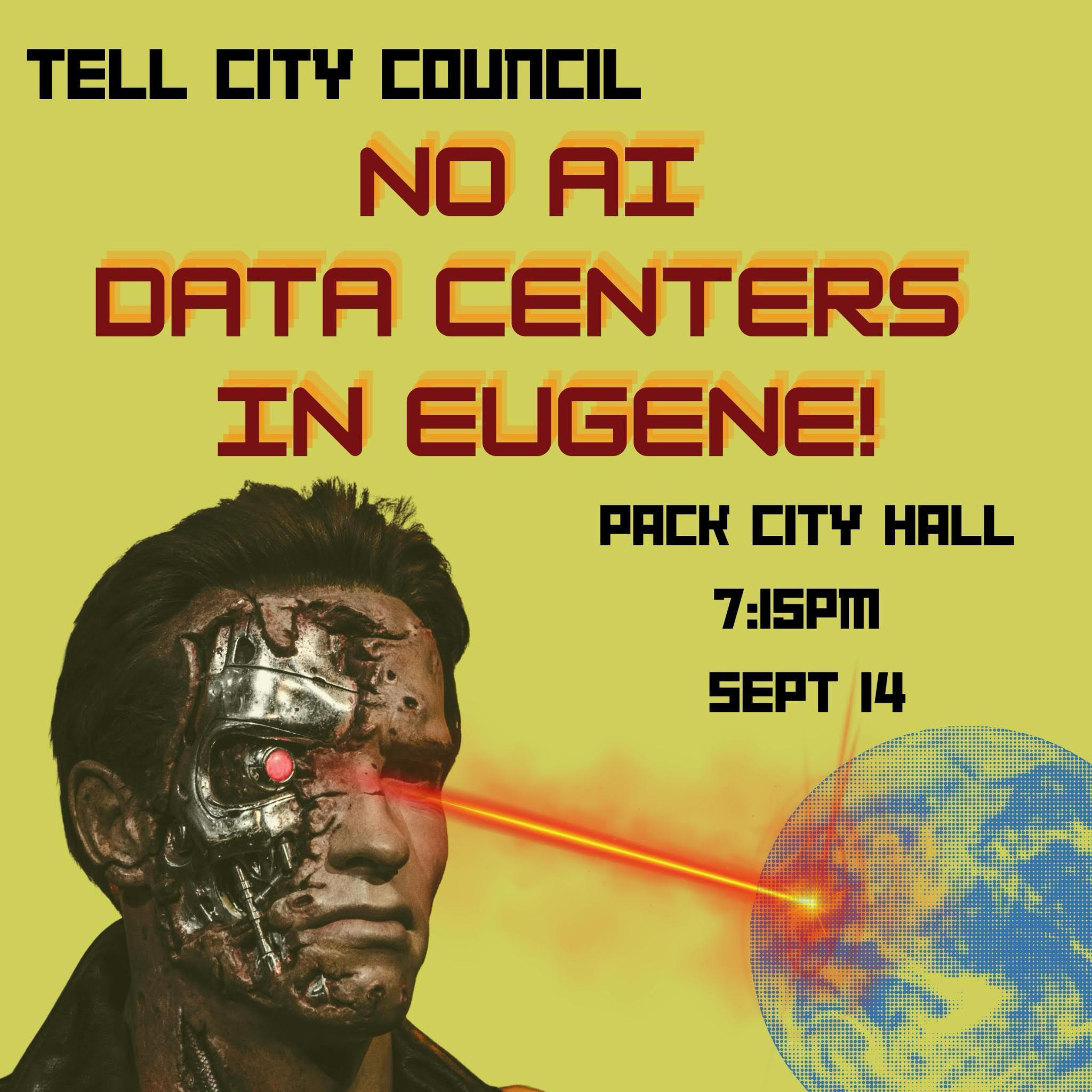
 TELL CITY COUNCIL NO DATA CENTERS IN EUGENE – SEPT 14
A data center developer has submitted a zoning verification to the City of Eugene to clarify whether a data center would be eligible to be constructed at the former Hynix semiconductor plant in West Eugene. This is the first proposal of what could be a wave of polluting (and evil) data center development in the city as tech companies seek low electricity costs and plentiful access to fresh water.
Join concerned community members on Monday, Sept 14 to tell the Council to establish a ban on data center development in the City, and to reject the current proposal to develop the former Hynix plant.
Talking Points (stay tuned for a full testimony guide in the coming weeks):
– Eugene must stop data center development: In light of the recent boom in data center construction in Oregon, the City of Eugene should protect residents from these polluting and wasteful facilities, reject the proposal to develop the former Hynix plant, and establish a complete ban on their development.
– Climate Impacts: Data centers require huge amounts of electricity, and run back up diesel generators, both of which would undermine the City of Eugene’s climate recovery ordinance goals to reduce community wide fossil fuel use by 50% by 2030.
– Huge Energy Demand: Conventional data centers have an average of 25 megawatts of power capacity, whereas the average house draws around 1.5 kilowatts on the grid at any given time. One conventional data center consumes the same amount of electricity to power roughly 20,000 homes. Hyperscaler data center energy consumption is around 100 megawatts, or the equivalent of 80,000 homes; the largest data center energy consumption is around 5,000 megawatts.
– Air Pollution: Data centers rely on back-up power generators to keep up with power demands during power outages or during high-peak consumption times. In a span of just 5 years, diesel generator use tripled nationally because of data center development. Diesel exhaust has a tremendous impact on human health contributing to illnesses such as asthma, heart disease, lung disease- particularly in young children, elderly adults, or those who already have pre-existing health concerns.
– Noise Pollution: Residents of existing data centers across the county are raising concerns about constant noise pollution from these operations. The cooling systems, fans, and diesel generators all contribute to a constant hum that is carried hundreds of meters away from these data centers. Communities around existing data centers have reported “headaches, vertigo, nausea, sleep disturbances, ear pain and hypertension” from nearby data centers.
– Water Pollution: Approximately 57% of all data centers use potable water to cool their servers, and up to 90% of that water is pulled from the surrounding watersheds (from lakes, rivers, or aquifers). Data centers in Loudoun County, Virginia, collectively used over 900 million gallons of water in 2023 alone. Water which has been used to cool data centers has been linked to increased concentration of water contaminants such as nitrates and polyfluroalkyl substances (PFAS), as well as thermal pollution by introducing warmer water back into the watershed. 99.9% of Lane County residents are currently experiencing drought conditions, and a new data center would take much needed water away from homes and businesses.
